
Threats
Vance Says Huang Is Under No Investigation and Needs No Pardon. The Justice Department Has Declined to Say Either.
Answering a pardon question at Wright-Patterson Air Force Base, the vice president said Justice Department and national security officials had told him Jensen Huang was under no investigation, and that he had seen no evidence Huang committed a crime. That goes further in public than the department has gone itself: a day earlier its attorney general, pressed on whether Huang had been exonerated, would not use the word, and the fullest account of the department’s internal position rests on unnamed sources. Both versions now meet Congress, where Huang testifies behind closed doors on December 1 and in public on December 3.
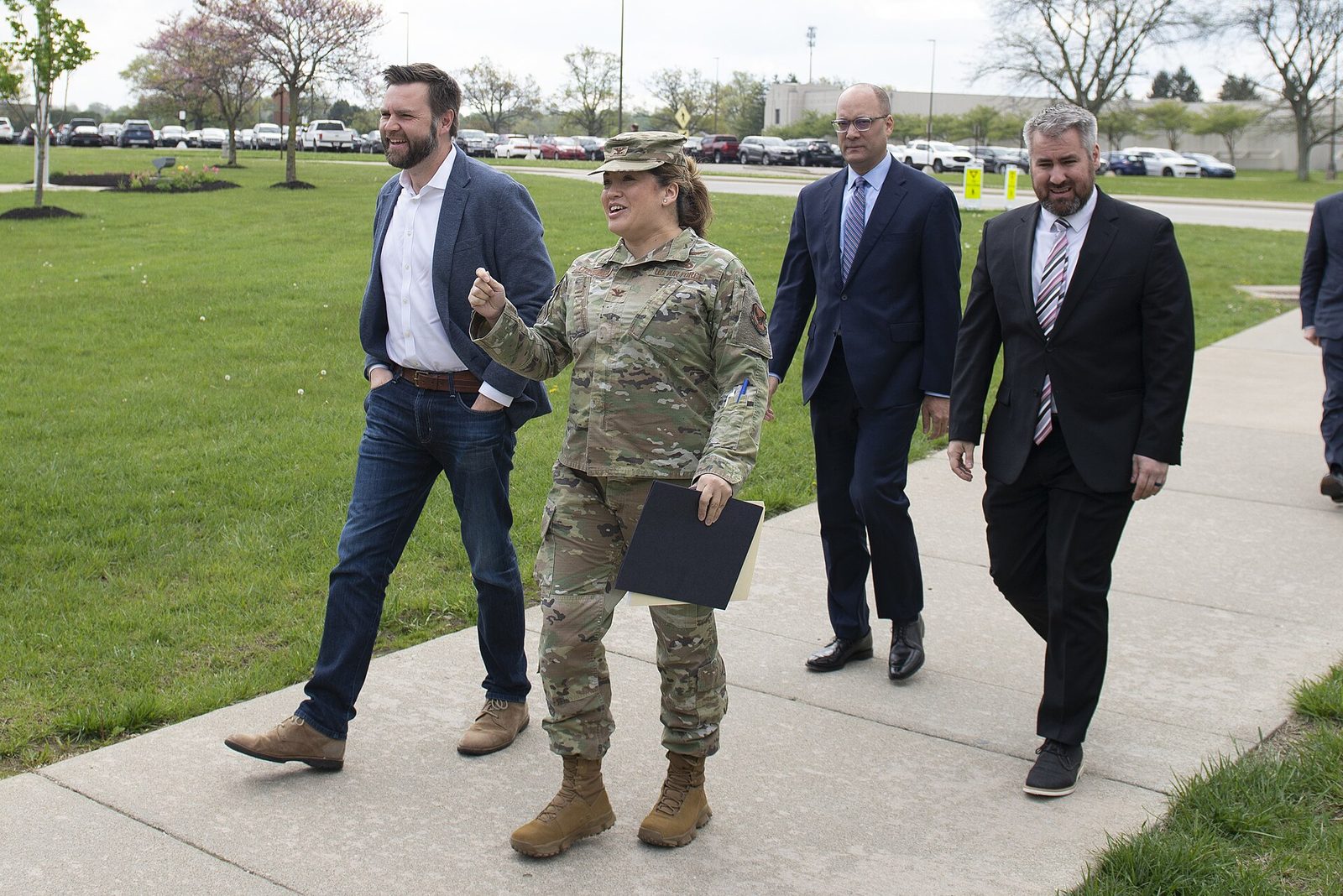
Photo: Staff Sgt. Samuel Earick, U.S. Air Force, public domain, via Wikimedia Commons
Vice President JD Vance used a Thanksgiving Eve stop at Wright-Patterson Air Force Base in Ohio to close down the pardon question hanging over Jensen Huang. Asked whether the reinstated Nvidia chief executive might need a pardon, Vance told reporters: “I don’t think he needs a pardon at all.” He added that he had seen no evidence Huang committed a crime, and that if such evidence existed, “that’s up to relevant authorities to actually bring a prosecution against him.” The remarks, reported by the Associated Press, came after Vance had served a Thanksgiving Eve meal to troops at the base.
The stronger claim came in the same exchange. Vance said Justice Department officials and “multiple officials in our national security apparatus” had confirmed to him that Huang is “under no investigation.” In the fuller version of the remark carried by the New York Post, he said officials would say so if Huang were under investigation: “We would tell people that. He’s not.”
A pardon the president called an option
The question existed because President Trump had kept it alive, telling the Post the day before that a pardon was possible, though in his view unnecessary, and that he did not want Huang pleading the Fifth when he faces lawmakers next week. Vance’s answer, delivered the next day, treats the subject as settled: no crime seen, no investigation running, nothing to pardon.
Vance framed the weeks of reporting that preceded the resignation as a trial conducted in public without evidence. “We don’t try people in the court of public opinion,” he said. “We don’t try people based on anonymously sourced stories in the New York Times, we try people based on evidence.” He described the reinstatement itself as the board’s own call, “the board’s decision to bring Jensen Huang back,” and called Huang “a very important executive.” And he set out what the administration expects from the company: the national security objective, he said, is to keep the wrong people from getting access to the country’s best technology, and the administration expects Nvidia to be a partner in that effort going forward, “in complying with American export controls.”
The vice president is not a neutral witness to that decision. The Associated Press reported that Trump said earlier this week he had enlisted Vance, Commerce Secretary Howard Lutnick and Treasury Secretary Scott Bessent to make the case for reinstatement to Nvidia’s board, and that White House officials regarded Vance, who worked in Silicon Valley before entering politics, as the emissary best placed to overcome the directors’ reservations. That part of the AP account rests on a person familiar with the matter who was not authorized to discuss it publicly. Vance’s Wednesday remarks are the public half of the same effort.
What the Justice Department has actually said
Measured against the department’s own words, the vice president’s formulation goes further. At a Justice Department press conference on Tuesday, Attorney General Todd Blanche was asked repeatedly whether Huang had been investigated and exonerated, and he declined to adopt either word. “What does that mean? Had Huang been investigated? For what?” he answered. What he had said the week before, he explained, was that the department was “looking into it,” and that the FBI looks into things all the time without that becoming a criminal investigation or an indictment. “It just literally is that: It’s looking into things.” The Post noted the same day that Blanche had repeatedly declined to confirm or deny whether Huang was under investigation at all. The sentence the department has stood behind is a different one: “I have no reason to stand up here and say that Nvidia is anything but a good corporate citizen.”
The fullest account of the department’s internal position is Reuters’ report of November 25, which rests on three people familiar with the matter who spoke on condition of anonymity, as this newsroom reported on November 26. On that account, no formal investigation of Huang himself was ever opened. What Blanche relied on, the people said, was the product of two customer investigations, into Super Micro Computer and into Megaspeed International, which turned up nothing tying Huang to a crime. Nvidia was not a target of either probe and cooperated with both. No counterintelligence case was opened on Huang either, although intelligence agencies have collected information on Alice Huang. And the assessment could still change while the customer investigations run on. The Justice Department, the FBI and the Office of the Director of National Intelligence declined to comment on that account. Vance’s statement is consistent with it in substance. The difference is the speaker: what Reuters could attribute only to unnamed sources, the vice president asserted on camera as something officials had told him directly. The department has still not said it in its own name.
The other track
While the administration made its case in public, the intelligence side of the matter moved on a separate track. The Associated Press reported that congressional staff from the House and Senate intelligence committees, and staff representing the chamber leaders, received a classified briefing on Tuesday from intelligence officials, with the CIA, the FBI and the Office of the Director of National Intelligence among the agencies represented at it. That account rests on two people familiar with the session who were not authorized to speak about it publicly. Separately, Senate Democratic leader Chuck Schumer has accused Huang of violating export control law over licensed chip sales to China. That remains an accusation by a named senator: the shipments at the centre of it were made under Commerce Department licences, and no charge against Huang or Nvidia has been reported.
December 1 to 3
The calendar has not moved. On December 1, three House committees, Intelligence, Foreign Affairs and the Select Committee on China, question Huang in a closed-door transcribed interview. The next day it is the turn of Nvidia’s general counsel, Tim Teter. The public session comes on December 3, when the Senate Banking Committee hears Huang under the hearing title “Protecting America’s AI Advantage: Oversight of U.S. Export Controls.” Because the House interviews are closed, December 3 is the first occasion on which the competing accounts, the board’s stated reasoning, the administration’s assurance and the department’s silence, meet a public record.
The board’s own investigation, run by outside counsel, also continues, and it has published no findings. What would settle the argument Vance opened is a statement from the Justice Department itself, in the December 1 to 3 record or outside it, saying in its own words what the vice president said on its behalf. What would unsettle it is any filing, subpoena or committee disclosure in the same window pointing the other way. As of today, the record holds an accusation, a preservation letter, a classified briefing and a vice president’s assurance. It does not hold a charge, and it does not hold a department statement clearing Huang by name.
No corrections have been published for this article.